
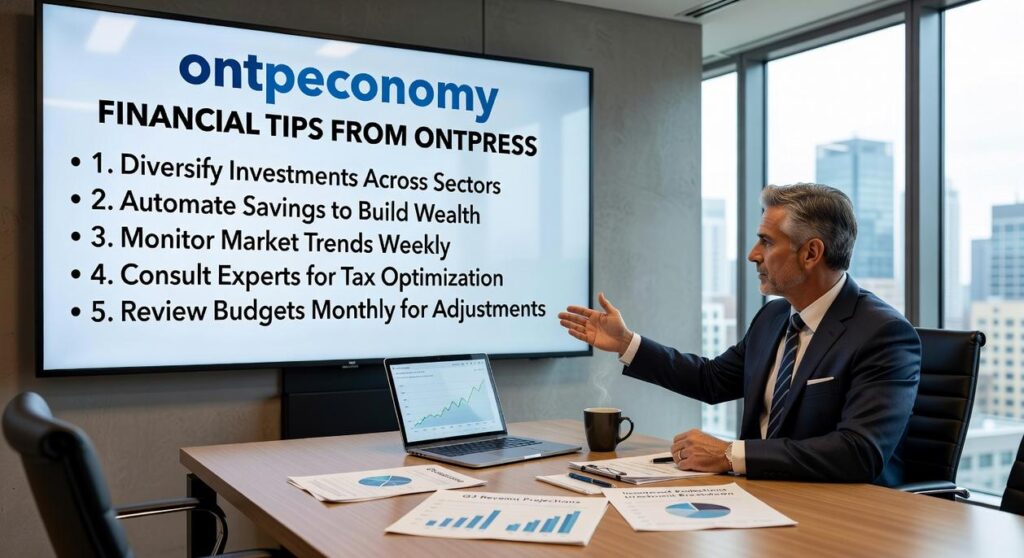
I’ve lived through Ontario’s wild cost of living swings. And I can tell you that most financial advice you’ll find online wasn’t written for us.
You’re dealing with provincial tax rules that don’t apply anywhere else in Canada. You’re watching housing costs that make your friends in other provinces shake their heads. Generic budgeting tips from some US finance blog? They don’t cut it here.
I started tracking ontpeconomy financial tips from ontpress because I needed real answers for Ontario’s specific challenges. Not recycled advice that ignores our reality.
This guide gives you financial strategies that actually work in Ontario. I’m talking about tactics that account for our tax structure, our market conditions, and our cost of living.
We analyze Ontario’s economy daily. We track provincial trends and capital flows that affect your wallet. That’s how I know the advice here fits what you’re dealing with right now.
You’ll learn how to manage your money better in a province where the rules are different. Where the costs are higher. Where the opportunities exist if you know where to look.
No fluff. Just practical financial tips built for Ontario residents.
Why Ontario-Specific Financial Advice Matters
You can’t build wealth with advice that doesn’t fit where you live.
I see it all the time. People follow generic Canadian financial tips and wonder why their numbers don’t add up. They miss out on thousands in credits they qualify for. They make housing decisions based on national averages that have nothing to do with Ontario’s reality.
Here’s what actually matters.
Your tax bill is different. Ontario has its own provincial tax brackets on top of federal ones. If you make $50,000, you’re paying 5.05% to the province. Hit $100,000 and that jumps to 11.16% on income above $98,463. Most financial content ignores this split and gives you useless take-home estimates.
You’re leaving money on the table. The Ontario Trillium Benefit combines energy costs, sales tax credits, and property tax relief into one payment. Many people don’t even know they qualify. Same with electricity support programs that can cut your bills if you meet income thresholds.
Want a practical example? Let’s say you earn $45,000 and rent in Ottawa. You could be getting over $300 annually from OTB alone (based on 2024 rates). That’s money you’re missing because you followed advice written for someone in Alberta.
Housing advice breaks down fast. A $500,000 home in Thunder Bay and a $500,000 condo in Toronto are completely different financial decisions. Carrying costs, appreciation rates, and market volatility vary wildly across the province. Generic mortgage calculators won’t tell you that.
I built ontpeconomy because Ontario needs its own financial roadmap. Not recycled national content.
Your province-specific situation deserves province-specific answers.
Practical Budgeting and Saving Strategies for Ontarians
You know what drives me crazy?
Opening your hydro bill in January and seeing a number that makes you wonder if you accidentally heated the entire neighborhood.
Or watching your car insurance renewal come in and realizing you’re paying more than your actual car payment. Welcome to Ontario, where the cost of living seems designed to drain your bank account faster than you can fill it.
I’ve talked to hundreds of Ontarians who feel like they’re doing everything right. They budget. They track expenses. They cut back on lattes (yes, that tired advice again).
But they still can’t seem to get ahead.
Here’s what nobody tells you. Generic budgeting advice doesn’t work here because Ontario has its own unique financial challenges. What works in Alberta or BC won’t cut it when you’re dealing with our specific tax structure and cost pressures.
Some financial experts say you should just earn more money. Real helpful, right? As if we haven’t thought of that. They act like the solution to high costs is simply increasing income, completely ignoring the reality that wages haven’t kept pace with housing and utility costs. In a world where financial advice often overlooks the struggles of everyday life, the rise of the Ontpeconomy highlights the urgent need for innovative solutions that address the disconnect between stagnant wages and soaring living costs. In a world where financial disparities continue to widen, the concept of an “Ontpeconomy” emerges as a critical perspective, challenging us to rethink how we approach economic growth and sustainability in gaming and beyond.
But here’s the truth.
You can’t budget your way out of systemic problems. But you can stop leaving money on the table.
I’m going to show you how to automate your savings around Ontario’s seasonal cost swings. We’ll cover the taxes guide Ontpeconomy strategies that actually matter, including credits most people miss.
Plus, I’ll break down how to tackle the big three expenses that hit Ontarians hardest: housing, transportation, and utilities.
Let’s start with something that actually works. ontpeconomy financial tips from ontpress focus on building systems that account for our reality, not some idealized version of personal finance.
Because budgeting in Thunder Bay looks nothing like budgeting in Toronto.
Smart Investing and Wealth Planning from an Ontario Perspective

Let me clear something up right away.
Building wealth in Ontario isn’t the same as building it anywhere else in Canada. The tax rules are different. The cost of living hits harder. And if you’re not paying attention to these details, you’re leaving money on the table.
I see investors make the same mistake over and over. They follow American investment advice or generic Canadian strategies that don’t account for Ontario’s specific tax structure.
Here’s what actually works.
Building a Resilient Ontario Portfolio
You want to minimize currency risk? Start with Canadian-domiciled ETFs and blue-chip stocks on the TSX.
When you buy U.S. stocks directly, you’re betting on two things. The company’s performance and the exchange rate. That’s double the risk.
TSX blue-chips give you exposure to solid companies without the currency headache. Think banks, utilities, telecom. Boring? Maybe. But they pay dividends in Canadian dollars that you can actually spend without conversion fees.
Retirement Planning That Makes Sense
CPP and OAS will cover your basics. But if you want more than basics, you need to stack your RRSP and TFSA the right way.
Your RRSP reduces taxable income now (which matters a lot if you’re in Ontario’s higher tax brackets). Your TFSA grows tax-free forever.
The Ontpeconomy Financial Advice by Ontpress approach is simple. Max out your RRSP while you’re working and in a high tax bracket. Then let your TFSA compound without ever touching it until you really need it.
Why the OSC Matters
The Ontario Securities Commission exists to keep you from getting scammed. They regulate who can give you investment advice and how your money gets handled. For gamers looking to navigate the complexities of investing in virtual currencies while staying compliant with regulations, the newly released Taxes Guide Ontpeconomy offers valuable insights to ensure you manage your finances wisely and avoid potential scams. For gamers looking to navigate the complexities of investing in virtual currencies while staying compliant with regulations, the newly released Taxes Guide Ontpeconomy offers essential insights to ensure your financial strategies are both effective and legally sound.
Only work with registered advisors. Period.
Capital Gains in Plain English
When you sell an investment for more than you paid, that’s a capital gain. In Ontario, you pay tax on 50% of that gain at your marginal rate.
So if you made $10,000 on a stock sale, you add $5,000 to your taxable income for the year.
The smart move? Hold investments in your TFSA when possible. No capital gains tax ever.
How to Identify Legitimate Financial News and Avoid Misinformation
I see it every day in Oklahoma City coffee shops and coworking spaces.
Someone pulls up their phone, reads a headline about the next big crypto play or stock tip, and suddenly they’re ready to move money.
Here’s what most people won’t tell you. Half the financial content you read online is garbage dressed up as analysis.
Now, some folks say you should just ignore all financial news and stick to index funds. They claim that trying to separate good information from bad is a waste of time. And honestly, I understand where they’re coming from. The noise can be overwhelming.
But think about it.
Shutting out all financial news means you miss real shifts in the economy. You don’t see when sectors are changing or when your portfolio needs adjusting.
The trick isn’t avoiding information. It’s knowing what to trust.
The Data Not Drama Rule
I look for numbers first. Real data from credible sources like the Federal Reserve, Bureau of Labor Statistics, or SEC filings.
If an article leads with fear or excitement instead of facts, I move on. Good financial analysis shows you the evidence before drawing conclusions.
Check Credentials and Conflicts
Does the writer have a background in finance or economics? Can you verify their track record?
More important: are they selling you something? If every article ends with a pitch for a specific product or service, that’s a red flag. (This applies to newsletter writers, YouTube channels, and those LinkedIn gurus equally.)
Spot the Scams For the full picture, I lay it all out in What Financial Help Can I Get Ontpeconomy.
Guaranteed returns don’t exist. Anyone promising them is lying.
Same goes for “secret strategies” or “limited time opportunities” that require you to act now. Real investments don’t disappear if you take a week to think.
At ontpress, we build our ontpeconomy financial tips on verifiable data and transparent analysis. No drama. No guarantees. Just the information you need to make your own calls. For gamers looking to navigate the complexities of in-game economies with confidence, Ontpeconomy Financial Advice by Ontpress offers a wealth of verifiable data and transparent analysis that empowers you to make informed decisions. For gamers eager to enhance their decision-making in virtual worlds, the insights provided through Ontpeconomy Financial Advice by Ontpress can serve as a vital resource grounded in data-driven analysis and transparency.
That’s the standard worth following.
Take Control of Your Ontario Financial Future Today
You came here looking for a clear path through Ontario’s financial landscape.
Now you have it.
I know how confusing it can feel when you’re trying to build wealth in a province with its own tax rules, credits, and economic quirks. But it doesn’t have to stay that way.
The strategies I’ve shared work because they’re built for Ontario residents. They account for the reality you’re living in right now.
You’ve got the framework. Budgeting that fits your actual expenses. Saving strategies that make sense with Ontario’s cost of living. Investment approaches that work in this market.
Here’s what matters most: taking action.
Pick one thing from this guide and do it today. Maybe it’s investigating that Ontario tax credit you’ve been ignoring (the Trillium Benefit alone could put hundreds back in your pocket). Or setting up an automatic transfer to your savings account.
ontpeconomy financial tips from ontpress are designed to be actionable, not theoretical.
Your financial future in Ontario is manageable. You just needed the right local knowledge to see it clearly.
Start small. Start now.
 Founder & Chief Executive Officer (CEO)
Elryssa Meldraina has opinions about capital flow strategies. Informed ones, backed by real experience — but opinions nonetheless, and they doesn't try to disguise them as neutral observation. They thinks a lot of what gets written about Capital Flow Strategies, Expert Tutorials, Financial Trends Tracker is either too cautious to be useful or too confident to be credible, and they's work tends to sit deliberately in the space between those two failure modes.
Reading Elryssa's pieces, you get the sense of someone who has thought about this stuff seriously and arrived at actual conclusions — not just collected a range of perspectives and declined to pick one. That can be uncomfortable when they lands on something you disagree with. It's also why the writing is worth engaging with. Elryssa isn't interested in telling people what they want to hear. They is interested in telling them what they actually thinks, with enough reasoning behind it that you can push back if you want to. That kind of intellectual honesty is rarer than it should be.
What Elryssa is best at is the moment when a familiar topic reveals something unexpected — when the conventional wisdom turns out to be slightly off, or when a small shift in framing changes everything. They finds those moments consistently, which is why they's work tends to generate real discussion rather than just passive agreement.
Founder & Chief Executive Officer (CEO)
Elryssa Meldraina has opinions about capital flow strategies. Informed ones, backed by real experience — but opinions nonetheless, and they doesn't try to disguise them as neutral observation. They thinks a lot of what gets written about Capital Flow Strategies, Expert Tutorials, Financial Trends Tracker is either too cautious to be useful or too confident to be credible, and they's work tends to sit deliberately in the space between those two failure modes.
Reading Elryssa's pieces, you get the sense of someone who has thought about this stuff seriously and arrived at actual conclusions — not just collected a range of perspectives and declined to pick one. That can be uncomfortable when they lands on something you disagree with. It's also why the writing is worth engaging with. Elryssa isn't interested in telling people what they want to hear. They is interested in telling them what they actually thinks, with enough reasoning behind it that you can push back if you want to. That kind of intellectual honesty is rarer than it should be.
What Elryssa is best at is the moment when a familiar topic reveals something unexpected — when the conventional wisdom turns out to be slightly off, or when a small shift in framing changes everything. They finds those moments consistently, which is why they's work tends to generate real discussion rather than just passive agreement.