

If you’re searching for a clear breakdown of inflation causes and effects, you’re likely trying to understand why prices keep rising—and what that means for your savings, investments, and long-term financial plans. This article is designed to give you exactly that: a focused, practical explanation of the forces that drive inflation and the real-world consequences that follow.
We’ll examine the core economic drivers behind inflation, from monetary expansion and supply shocks to demand imbalances and capital flow shifts. Then, we’ll connect those drivers to their tangible impacts—purchasing power erosion, asset price distortion, interest rate changes, and wealth redistribution—so you can see how inflation moves through the broader economy.
Our analysis is grounded in established economic fundamentals, historical data trends, and real-world market behavior. By the end, you’ll not only understand inflation in theory, but also how to interpret it strategically and respond with informed financial decisions.
Last year, your weekly grocery bill was $120. Now it’s $150, and the bag somehow feels lighter. That creeping squeeze is inflation—the gradual rise in prices that quietly shrinks what your money can buy.
Economists debate the exact triggers; even experts disagree on timing and scale. Still, understanding inflation causes and effects helps you respond instead of react.
Here’s what it touches:
- Savings lose purchasing power.
- Wages may lag behind costs.
- Everyday essentials strain budgets.
I can’t promise certainty about where prices head next. But grasping this core principle is the first step toward sound financial decisions.
Decoding Inflation: The Basics of Purchasing Power
To fully grasp the complexities of inflation, it’s also essential to explore how currency fluctuations, as detailed in our article on ‘Exchange Ftasiatrading‘, can significantly impact purchasing power and economic stability.
Inflation is the rate at which the general level of prices for goods and services rises, leading to a fall in the value of currency. In plain terms, your money buys less over time. Think of it this way: $100 today fills a full basket of groceries, but in five years, that same $100 might only buy three-quarters of a basket. Nothing about the bill changed—yet your purchasing power (what your money can actually buy) shrank.
So how do economists track this? Primarily through the Consumer Price Index (CPI), which measures the average change over time in prices paid by urban consumers for a standardized “market basket” of goods and services. This basket includes everyday items like food, rent, transportation, and healthcare.
While many outlets discuss inflation causes and effects, few connect them directly to household cash flow—where inflation quietly reshapes budgets first (and most painfully).
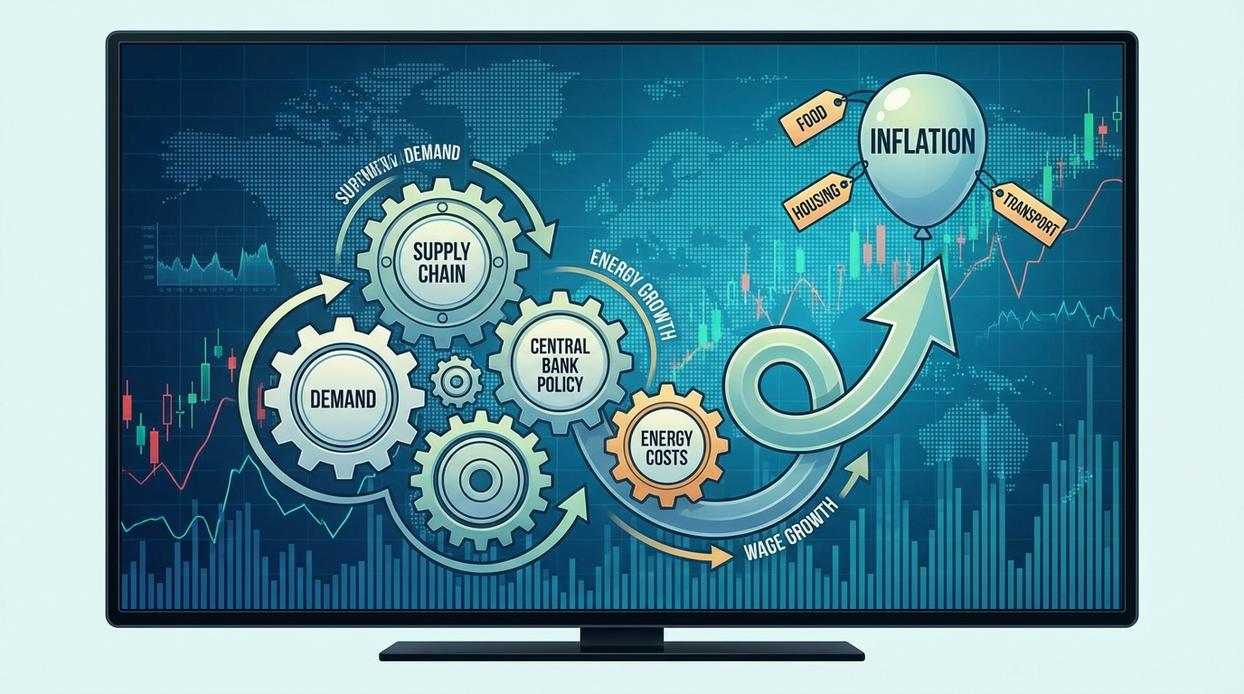
Inflation rarely has a single villain. Economists still debate which forces matter most at any given moment, and I’ll admit the picture is often messier than headlines suggest. Still, three classic engines help explain most inflation causes and effects.
Demand-Pull Inflation: Too Much Money Chasing Too Few Goods
Demand-pull inflation happens when overall spending outpaces the economy’s ability to produce. In simple terms, consumers want more than businesses can supply. Imagine a round of government stimulus checks landing in bank accounts. Households feel flush, retail sales jump, travel bookings surge, and suddenly inventories look thin. A booming job market can create the same dynamic; when people feel secure, they spend confidently (sometimes like it’s a holiday sale that never ends). Prices rise not because goods are worse, but because they’re scarce relative to demand. Some argue strong demand is purely positive. They’re partly right—growth is good—but if supply can’t respond quickly, prices climb.
Cost-Push Inflation: When Production Gets More Expensive
Cost-push inflation starts on the production side. If oil prices spike, transportation becomes pricier, and nearly every product—from groceries to electronics—absorbs that cost. Supply chain disruptions, such as factory shutdowns or shipping bottlenecks, squeeze availability and raise input expenses. Businesses, facing thinner margins, pass costs to consumers. It’s not always clear how much of a price hike reflects genuine cost pressure versus opportunism, and economists continue to argue over that gray area.
- Higher raw material costs
- Energy price shocks
- Logistics constraints
Built-in Inflation: The Wage-Price Spiral
Built-in inflation reflects expectations. Workers seek higher wages to offset rising living costs. Firms increase prices to cover payroll. Workers then push for another raise. Around and around it goes. Whether this spiral takes hold depends on psychology as much as policy—and predicting human expectations is, admittedly, no exact science at present time today.
The Ripple Effect: How Inflation Changes Your Financial World
Inflation isn’t just an abstract economic term—it quietly reshapes your entire financial life. At its core, inflation means prices rise and purchasing power falls. When the average U.S. inflation rate hit 8.0% in 2022 (U.S. Bureau of Labor Statistics), many households felt the squeeze almost overnight.
Impact on Savers
If your savings account earns 1% interest while inflation runs at 3%, your real return (your return after adjusting for inflation) is negative 2%. In practical terms, $10,000 today buys less next year—even though the balance number looks bigger. According to the FDIC, average savings rates often trail inflation, meaning cautious savers steadily lose purchasing power (a slow leak many don’t notice).
Impact on Borrowers vs. Lenders
Inflation redistributes wealth:
- Borrowers with fixed-rate loans repay debt with money that’s worth less over time. A homeowner locked into a 3% 30-year mortgage before 2022 effectively benefits if wages and prices rise.
- Lenders receive fixed payments that lose real value. Research from the Federal Reserve shows unexpected inflation typically reduces real returns for bondholders.
Impact on Investors
Stocks sometimes hedge inflation because companies can raise prices. However, high inflation can compress profit margins if costs rise faster than revenues. Bonds are particularly vulnerable since fixed coupon payments lose purchasing power. This dynamic is central to understanding inflation causes and effects across asset classes.
Impact on Day-to-Day Life
Rising costs of food, fuel, and housing reduce discretionary income. When groceries jump 10% year-over-year, families cut travel or dining out (goodbye, spontaneous weekend trips).
To grasp the mechanics behind price shifts, revisit supply and demand fundamentals in modern markets. Understanding these forces turns inflation from a mystery into a measurable trend.
Protecting Your Wealth: Strategies for a High-Inflation Environment
A few years ago, I noticed my grocery bill climbing while my savings account earned almost nothing. That was my wake-up call. Inflation quietly erodes purchasing power—the amount your money can actually buy—and if you’re not proactive, it wins.
So, where do you start? First, understand inflation hedging, which means investing in assets that historically hold value as prices rise. Real estate often benefits from rising rents, commodities like gold and oil tend to track price increases, and Treasury Inflation-Protected Securities (TIPS) adjust with inflation (U.S. Treasury data). Still, some argue cash feels safer during volatility. I get that. But over time, uninvested cash typically loses value (Bureau of Labor Statistics data on CPI trends).
That’s why investing matters. Equities and growth assets have historically outpaced inflation long term (S&P historical returns). In addition, review your budget regularly and revisit goals. Understanding inflation causes and effects helps you adjust before higher costs derail your plan.
Inflation is a fundamental economic force shaping every paycheck, price tag, and portfolio decision. Understanding inflation causes and effects isn’t academic trivia; it’s financial armor. Looking ahead, persistent deficits and shifting supply chains may keep pressures elevated—though that’s speculation. Ultimately, economic literacy empowers investing, steadier wealth building, and long-term resilience.
Take Control of Rising Costs Before They Control You
You set out to better understand inflation causes and effects, and now you have a clearer picture of what’s driving rising prices and how they ripple through savings, investments, and everyday expenses. From supply shocks and monetary expansion to shifting demand cycles, the forces behind inflation are no longer abstract—they’re actionable.
The real pain point isn’t just higher prices. It’s the silent erosion of purchasing power, shrinking margins, and uncertainty about how to protect your wealth in volatile conditions. Ignoring inflation means falling behind. Preparing for it means staying ahead.
Now it’s time to act. Start adjusting your capital allocation, review your exposure to inflation-sensitive assets, and apply disciplined wealth-planning strategies designed for changing economic cycles.
If you’re ready to turn economic uncertainty into strategic opportunity, explore our in-depth market insights and capital flow strategies today. Join thousands of readers who rely on our data-driven analysis to stay ahead of inflation—not react to it. Start now and protect what you’ve worked hard to build.
 Founder & Chief Executive Officer (CEO)
Elryssa Meldraina has opinions about capital flow strategies. Informed ones, backed by real experience — but opinions nonetheless, and they doesn't try to disguise them as neutral observation. They thinks a lot of what gets written about Capital Flow Strategies, Expert Tutorials, Financial Trends Tracker is either too cautious to be useful or too confident to be credible, and they's work tends to sit deliberately in the space between those two failure modes.
Reading Elryssa's pieces, you get the sense of someone who has thought about this stuff seriously and arrived at actual conclusions — not just collected a range of perspectives and declined to pick one. That can be uncomfortable when they lands on something you disagree with. It's also why the writing is worth engaging with. Elryssa isn't interested in telling people what they want to hear. They is interested in telling them what they actually thinks, with enough reasoning behind it that you can push back if you want to. That kind of intellectual honesty is rarer than it should be.
What Elryssa is best at is the moment when a familiar topic reveals something unexpected — when the conventional wisdom turns out to be slightly off, or when a small shift in framing changes everything. They finds those moments consistently, which is why they's work tends to generate real discussion rather than just passive agreement.
Founder & Chief Executive Officer (CEO)
Elryssa Meldraina has opinions about capital flow strategies. Informed ones, backed by real experience — but opinions nonetheless, and they doesn't try to disguise them as neutral observation. They thinks a lot of what gets written about Capital Flow Strategies, Expert Tutorials, Financial Trends Tracker is either too cautious to be useful or too confident to be credible, and they's work tends to sit deliberately in the space between those two failure modes.
Reading Elryssa's pieces, you get the sense of someone who has thought about this stuff seriously and arrived at actual conclusions — not just collected a range of perspectives and declined to pick one. That can be uncomfortable when they lands on something you disagree with. It's also why the writing is worth engaging with. Elryssa isn't interested in telling people what they want to hear. They is interested in telling them what they actually thinks, with enough reasoning behind it that you can push back if you want to. That kind of intellectual honesty is rarer than it should be.
What Elryssa is best at is the moment when a familiar topic reveals something unexpected — when the conventional wisdom turns out to be slightly off, or when a small shift in framing changes everything. They finds those moments consistently, which is why they's work tends to generate real discussion rather than just passive agreement.