
Understanding where the economy is headed—especially in a world increasingly shaped by digital assets—requires more than headlines and market noise. If you’re searching for clarity on financial trends, capital flows, and the deeper forces driving on-chain markets, this article is designed to give you exactly that. We break down the core economic fundamentals influencing today’s landscape, interpret key blockchain economic health indicators, and explain how capital flow strategies are evolving across both traditional and decentralized systems.
Rather than speculation, you’ll find structured analysis grounded in macroeconomic principles, on-chain data models, and practical wealth planning frameworks. Our approach integrates financial trend analysis with real-time blockchain metrics to help you connect short-term movements with long-term strategy. By the end, you’ll have a clearer understanding of how to interpret market signals, assess economic strength within blockchain ecosystems, and position your capital with greater confidence and precision.
Traditional economic reports arrive weeks late. By the time GDP or CPI is published, markets have already moved. That delay creates blind spots for investors who need current signals.
Public blockchains, however, stream transaction data in real time. Wallet activity, stablecoin flows, and gas fees act as blockchain economic health indicators. They reveal capital movement, user demand, and network stress instantly.
Feature: Transparent ledgers update every block.
Benefit: You see liquidity shifts before headlines catch up.
Skeptics argue crypto activity is too niche to reflect the broader economy. Yet stablecoin volumes now rival mid-sized payment networks (hardly fringe anymore). Globally.
Traditional metrics like GDP and CPI were built for an industrial economy, not a digital one. Their reporting cycle is painfully slow. By the time quarterly GDP prints or monthly CPI updates arrive, markets have already repriced risk. That lag distorts decisions. I believe relying on backward-looking data in a real-time economy is like driving using only the rearview mirror (thrilling, but reckless).
Centralized finance makes it worse. Bank balance sheets, settlement layers, and risk exposure remain closed, permissioned, and selectively disclosed. We’re expected to trust summaries instead of raw data. Public blockchains flip that script. Anyone can audit flows, verify reserves, and track activity in real time. That transparency enables blockchain economic health indicators that update by the block.
Traditional frameworks also fail to measure value inside DeFi protocols, NFT markets, and gaming economies. Capital moves at internet speed and our metrics should too. Now not last quarter matters.
Core Indicator 1: Stablecoin Supply and Velocity
Stablecoins as a Proxy for Liquidity
Stablecoins—crypto assets pegged to fiat currencies like the U.S. dollar—function as the base liquidity layer of the on-chain economy. Think of them as digital cash waiting on the sidelines. When total stablecoin supply grows, it usually signals fresh capital entering crypto markets (similar to rising bank reserves in traditional finance). According to public issuer reports from Tether and Circle, aggregate supply often expands during bullish cycles and contracts during downturns.
Reading the Signals
An increasing stablecoin supply typically reflects a risk-on appetite—investors preparing to deploy capital into volatile assets. A declining supply suggests capital flight and a risk-off stance. Some argue supply alone is misleading because tokens can migrate between chains. Fair point—but aggregate supply across major issuers still offers one of the clearest blockchain economic health indicators available.
Measuring Economic Activity with Velocity
Stablecoin velocity—total transaction volume divided by total supply—is the on-chain equivalent of the “velocity of money.” High velocity means funds are moving frequently (economic energy). Low velocity? Capital is idle.
Practical Application
Here’s what you should do:
- Track USDT and USDC market caps on CoinGecko or CoinMarketCap.
- Verify supply changes via Etherscan or TronScan.
- Compare 30-day transaction volume to supply for velocity trends.
Recommendation: Monitor both supply and velocity weekly. Supply tells you how much fuel exists; velocity tells you whether the engine is running.
Core Indicator 2: Network Transaction Fees and Active Addresses
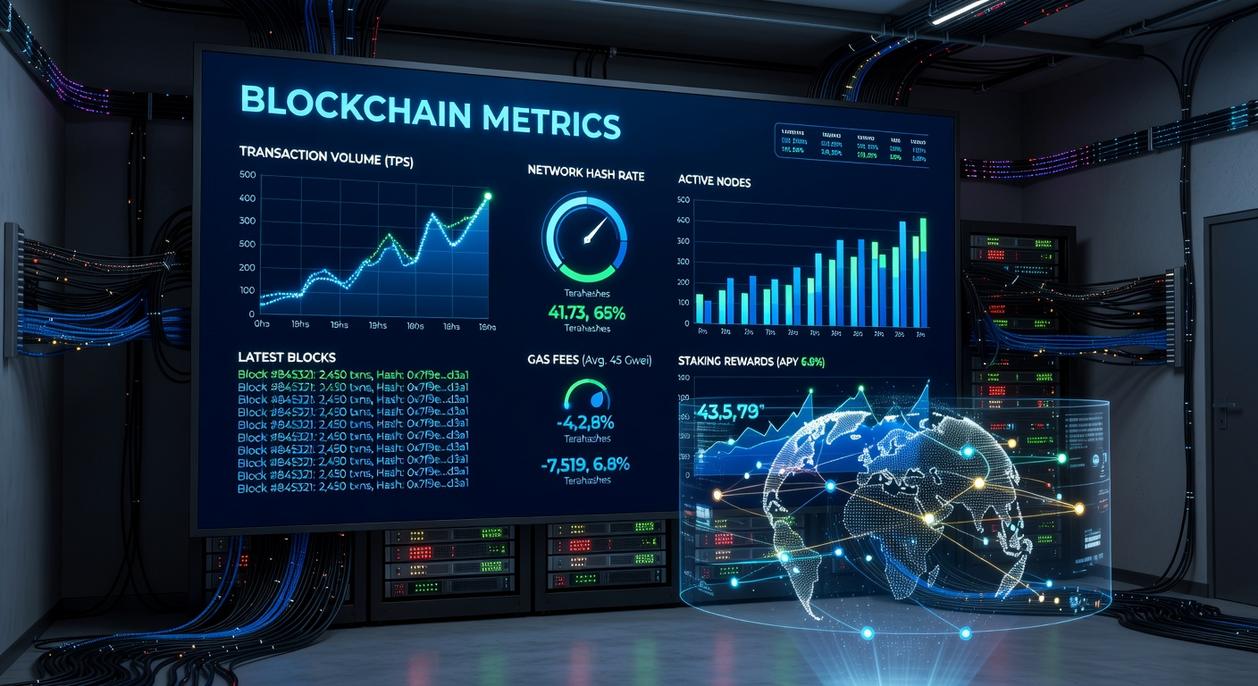
Transaction fees (often called gas fees) are the price users pay to have their transactions processed on a blockchain. Think of blockspace as limited seating on a flight: when demand rises, prices go up. Sustained high fees signal persistent demand for that limited space—an indicator of real usage, not just speculation. This is why many analysts treat fees as one of the clearest blockchain economic health indicators.
That said, critics argue fees can spike for the “wrong” reasons—like a hyped NFT mint or token launch. They’re right. A one-day surge doesn’t prove long-term strength. The key is tracking average transaction fees over time, not reacting to isolated spikes (zoom out before you panic).
Next, consider active addresses—the number of unique wallets sending or receiving transactions daily or monthly. In simple terms, it’s a user growth metric. Consistent increases suggest expanding adoption and deeper engagement.
For deeper context, explore analyzing transaction fees as an economic signal.
Finally, compare total fees paid to total transaction volume. A rising ratio can indicate users are willing to pay meaningful costs for economic activity—a subtle but powerful wealth-planning insight.
Total Value Locked (TVL) is the aggregate capital deposited in a DeFi protocol’s smart contracts—think of it as the combined liquidity sitting in Aave on Ethereum or in a Solana-based DEX pool. When TVL rises, it often signals user confidence in code security and yield durability; when it falls, capital is quietly heading for the exits.
In practice, analysts track sector rotation much like Wall Street watches ETF flows. During 2024’s liquid staking boom, capital migrated from lending desks to LST platforms as traders chased staking APR compression. That rotation reveals sentiment before price charts do
The TVL-to-Market Cap ratio compares secured capital to token valuation:
| Metric | What It Signals |
|—|—|
| Low Ratio | Potential undervaluation |
| High Ratio | Speculative premium |
Used alongside blockchain economic health indicators, this model shows whether a protocol’s token price reflects economic gravity or narrative heat.
On-chain data is powerful, but it is VOLATILE. Compared to traditional indicators like GDP or earnings, metrics such as active addresses can swing wildly week to week. Zooming out helps reveal durable trends. Critics argue the numbers are easily gamed through Sybil attacks and wash trading. They are right, partially.
- Heuristics filter fake wallets
- Volume adjusted for anomalies
Still, correlation is not causation. Blockchain economic health indicators show patterns, not motives. My speculation: regulators will push stricter transparency, reducing manipulation over time. Expect smarter filters ahead. That shift could stabilize sentiment and pricing cycles long term. But uncertainty remains. Always.
Building a Forward-Looking Economic Dashboard
You now have a practical toolkit of leading, real-time indicators—stablecoin flows, network fees, and DeFi TVL—to read economic momentum at the source. Traditional reports lag by weeks or months; on-chain data updates by the block (yes, sometimes seconds).
A vs. B: Government GDP release vs. live transaction volume. Survey-based lending data vs. transparent liquidity pools. Which would you rather steer capital with?
By focusing on blockchain economic health indicators, you bypass reporting delays and see capital formation unfold in real time.
- Start by tracking one major network’s stablecoin inflows this week.
That’s your dashboard’s heartbeat.
Strengthen Your Position in the Digital Economy
You came here to better understand how capital flows, market cycles, and on-chain signals shape today’s financial landscape. Now you have a clearer view of how these forces interact — and how blockchain economic health indicators reveal what traditional metrics often miss.
Markets move fast. Capital rotates. Liquidity expands and contracts. Without a structured framework, it’s easy to misread momentum or react too late. By grounding your strategy in data-driven models and on-chain fundamentals, you reduce uncertainty and position yourself ahead of structural shifts — not behind them.
The next step is simple: start applying these insights. Track blockchain economic health indicators consistently. Align your capital allocation with observable trends. Refine your wealth planning strategy using transparent, measurable signals — not speculation.
If you’re serious about navigating volatility with clarity and confidence, now is the time to act. Access proven frameworks, practical tutorials, and data-backed capital flow strategies designed to help you stay ahead of economic cycles. Join thousands of forward-thinking investors who rely on structured insights to protect and grow their wealth.
Don’t wait for the next market swing to test your strategy. Strengthen it today.
 Founder & Chief Executive Officer (CEO)
Elryssa Meldraina has opinions about capital flow strategies. Informed ones, backed by real experience — but opinions nonetheless, and they doesn't try to disguise them as neutral observation. They thinks a lot of what gets written about Capital Flow Strategies, Expert Tutorials, Financial Trends Tracker is either too cautious to be useful or too confident to be credible, and they's work tends to sit deliberately in the space between those two failure modes.
Reading Elryssa's pieces, you get the sense of someone who has thought about this stuff seriously and arrived at actual conclusions — not just collected a range of perspectives and declined to pick one. That can be uncomfortable when they lands on something you disagree with. It's also why the writing is worth engaging with. Elryssa isn't interested in telling people what they want to hear. They is interested in telling them what they actually thinks, with enough reasoning behind it that you can push back if you want to. That kind of intellectual honesty is rarer than it should be.
What Elryssa is best at is the moment when a familiar topic reveals something unexpected — when the conventional wisdom turns out to be slightly off, or when a small shift in framing changes everything. They finds those moments consistently, which is why they's work tends to generate real discussion rather than just passive agreement.
Founder & Chief Executive Officer (CEO)
Elryssa Meldraina has opinions about capital flow strategies. Informed ones, backed by real experience — but opinions nonetheless, and they doesn't try to disguise them as neutral observation. They thinks a lot of what gets written about Capital Flow Strategies, Expert Tutorials, Financial Trends Tracker is either too cautious to be useful or too confident to be credible, and they's work tends to sit deliberately in the space between those two failure modes.
Reading Elryssa's pieces, you get the sense of someone who has thought about this stuff seriously and arrived at actual conclusions — not just collected a range of perspectives and declined to pick one. That can be uncomfortable when they lands on something you disagree with. It's also why the writing is worth engaging with. Elryssa isn't interested in telling people what they want to hear. They is interested in telling them what they actually thinks, with enough reasoning behind it that you can push back if you want to. That kind of intellectual honesty is rarer than it should be.
What Elryssa is best at is the moment when a familiar topic reveals something unexpected — when the conventional wisdom turns out to be slightly off, or when a small shift in framing changes everything. They finds those moments consistently, which is why they's work tends to generate real discussion rather than just passive agreement.