

If you’re relying on a static, set-and-forget portfolio, you could be leaving serious money on the table. In today’s fast-moving economy, capital doesn’t sit still—and neither should your investments. Markets rotate through cycles, sectors rise and fall, and asset classes respond differently to shifting macro conditions. This guide shows you how to adapt using capital rotation strategies designed to capture upside while managing downside risk. You’ll learn the signals that matter, how to reposition between sectors with confidence, and the modern tools that help you act with precision—so your portfolio works as dynamically as the economy itself.
Capital rotation is the deliberate shift of money from one sector to another based on where growth is likely to appear next. In simple terms, investors sell assets in industries that look overheated or slowing and redeploy funds into areas positioned for expansion. This differs from rebalancing, which merely resets a portfolio to its original percentages. Rotation changes the percentages on purpose to pursue stronger performance.
Think of rebalancing as tidying your room. Rotation is moving to a new house.
Why does this matter? Because the economy moves in cycles: expansion, peak, contraction, and trough. Different sectors lead in each phase. Technology may thrive in expansion, while utilities often hold up during contraction (boring, but dependable).
A static portfolio fits only one phase well. Investors using capital rotation strategies aim to follow shifting leadership and understand how global capital flows influence currency markets to anticipate momentum. Timing remains critically important.
Decoding the Market: Key Triggers for a Portfolio Shift
Let’s be honest—few things are more frustrating than watching your portfolio slide while headlines scream “strong economy.” The disconnect is real. The problem isn’t usually effort. It’s misreading the signals.
Macroeconomic Indicators as Your Compass
Macroeconomic indicators are broad data points that show the economy’s overall health. Think of them as your market weather report (and yes, sometimes it feels just as unpredictable).
- Interest Rates: When rates rise, borrowing costs increase. Growth-heavy tech stocks often suffer because future profits become less attractive at higher discount rates (Federal Reserve data). Meanwhile, banks can benefit from wider lending margins. Ignoring rate cycles is like ignoring gravity.
- Inflation (CPI/PPI): The Consumer Price Index (CPI) and Producer Price Index (PPI) measure price increases at retail and wholesale levels. Elevated inflation has historically supported energy and commodity sectors as raw material prices climb (Bureau of Labor Statistics).
- GDP & Employment: Strong GDP and low unemployment often boost cyclical stocks—companies tied to consumer spending and industrial demand. When growth slows, defensive sectors tend to outperform.
Technical & Sentiment Analysis
Economic data sets direction. Market data confirms it.
- Sector Performance Charts: Relative strength compares how one sector performs against another. Leaders tend to keep leading (momentum is stubborn like that).
- Volatility Index (VIX): The VIX tracks expected market volatility. Rising levels often push investors toward utilities and consumer staples for stability (CBOE data).
If you’re tired of reacting late, integrate capital rotation strategies with both macro and technical signals. It won’t eliminate noise—but it will reduce regret.
Actionable Rotation Strategies for Modern Investors
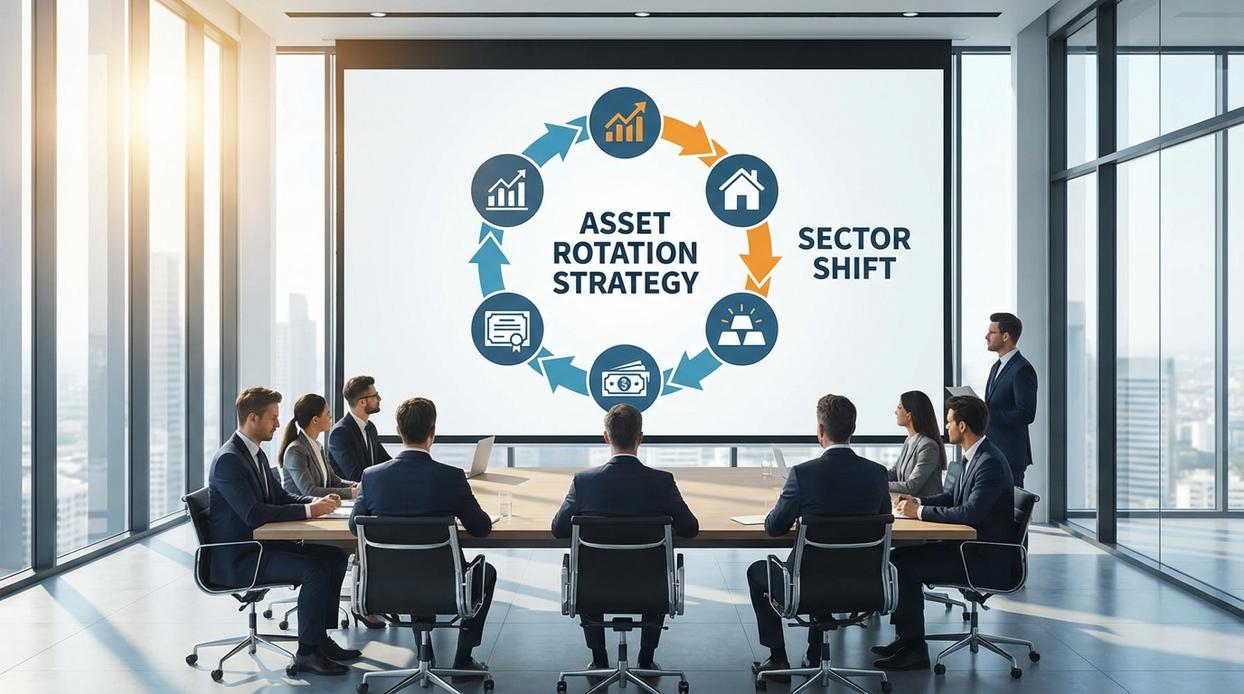
I learned the importance of rotation the hard way in early 2020. I was overweight tech, riding the momentum, convinced the rally would last forever (famous last words). When volatility spiked, I realized I wasn’t investing—I was drifting. That moment pushed me to study capital rotation strategies more deliberately.
The Classic: Cyclical vs. Defensive Rotation
Cyclical stocks (companies whose earnings rise and fall with the economy) tend to outperform during expansion. Think technology, industrials, and consumer discretionary—businesses that thrive when spending is strong. After GDP growth turned positive in 2021, for example, the S&P 500’s cyclical sectors outpaced defensives (Source: S&P Global sector performance reports).
Defensive stocks—healthcare, utilities, consumer staples—hold up better during slowdowns because demand for medicine and electricity doesn’t vanish in recessions. During the 2008 crisis, consumer staples significantly outperformed the broader market (Source: Morningstar data).
Pro tip: Watch leading indicators like ISM Manufacturing data before rotating (they often shift before headlines do).
The Value vs. Growth Tilt
This rotation hinges on interest rates. Growth stocks (firms expected to generate higher future earnings) benefit from low or falling rates because future cash flows are discounted less. In contrast, value stocks (companies trading at lower price-to-earnings ratios) tend to shine when rates rise, as strong present cash flows matter more (Source: Fama-French research).
Inter-Market Rotation
Rotation isn’t just sector-based. Investors often shift between stocks, bonds, and commodities based on risk appetite. When fear rises, bonds may outperform; when inflation expectations climb, commodities can lead. Think of it less like timing the market and more like adjusting sails when the wind changes.
Tools of the Trade: Tracking Capital Flows in Real-Time
Think of the market like an airport terminal. Capital is the crowd, constantly boarding new flights. Sector-specific ETFs—like XLK (tech), XLE (energy), and XLF (financials)—are your express gates. Instead of buying dozens of individual stocks, you rotate with one click. That’s the appeal of capital rotation strategies: efficient repositioning without juggling multiple trades (less chaos, fewer moving parts).
If ETFs are the gates, capital flow heatmaps are the departure boards. Platforms such as Finviz visualize inflows and outflows, showing which sectors are “boarding” investors in real time. Green clusters often signal momentum; red patches hint at capital exiting.
For crypto portfolios, on-chain data works like blockchain traffic cameras. Exchange inflows may suggest selling pressure, while whale accumulation can foreshadow breakouts. Stablecoin spikes? Often a parking lot for sidelined cash.
Some argue this is just noise. But like weather radar, flow data doesn’t predict everything—it simply helps you carry an umbrella when clouds gather.
Position Your Portfolio for What Comes Next
Market leadership never stays the same. You’ve seen how economic cycles shift power from one sector to another—and why mastering capital rotation strategies is essential for protecting and compounding your wealth.
If you stay passive, your portfolio remains exposed to inevitable boom-and-bust cycles that can quietly erode years of gains. That’s the real risk: not volatility, but being unprepared for it.
Now it’s time to act. Identify the current economic phase and assess whether your sector allocations truly align with it. Use macroeconomic triggers and modern tracking tools to get ahead of the next shift.
Don’t wait for the market to correct you. Join thousands of investors who rely on our proven economic insights and data-driven frameworks to stay ahead. Start optimizing your portfolio today.
 Founder & Chief Executive Officer (CEO)
Elryssa Meldraina has opinions about capital flow strategies. Informed ones, backed by real experience — but opinions nonetheless, and they doesn't try to disguise them as neutral observation. They thinks a lot of what gets written about Capital Flow Strategies, Expert Tutorials, Financial Trends Tracker is either too cautious to be useful or too confident to be credible, and they's work tends to sit deliberately in the space between those two failure modes.
Reading Elryssa's pieces, you get the sense of someone who has thought about this stuff seriously and arrived at actual conclusions — not just collected a range of perspectives and declined to pick one. That can be uncomfortable when they lands on something you disagree with. It's also why the writing is worth engaging with. Elryssa isn't interested in telling people what they want to hear. They is interested in telling them what they actually thinks, with enough reasoning behind it that you can push back if you want to. That kind of intellectual honesty is rarer than it should be.
What Elryssa is best at is the moment when a familiar topic reveals something unexpected — when the conventional wisdom turns out to be slightly off, or when a small shift in framing changes everything. They finds those moments consistently, which is why they's work tends to generate real discussion rather than just passive agreement.
Founder & Chief Executive Officer (CEO)
Elryssa Meldraina has opinions about capital flow strategies. Informed ones, backed by real experience — but opinions nonetheless, and they doesn't try to disguise them as neutral observation. They thinks a lot of what gets written about Capital Flow Strategies, Expert Tutorials, Financial Trends Tracker is either too cautious to be useful or too confident to be credible, and they's work tends to sit deliberately in the space between those two failure modes.
Reading Elryssa's pieces, you get the sense of someone who has thought about this stuff seriously and arrived at actual conclusions — not just collected a range of perspectives and declined to pick one. That can be uncomfortable when they lands on something you disagree with. It's also why the writing is worth engaging with. Elryssa isn't interested in telling people what they want to hear. They is interested in telling them what they actually thinks, with enough reasoning behind it that you can push back if you want to. That kind of intellectual honesty is rarer than it should be.
What Elryssa is best at is the moment when a familiar topic reveals something unexpected — when the conventional wisdom turns out to be slightly off, or when a small shift in framing changes everything. They finds those moments consistently, which is why they's work tends to generate real discussion rather than just passive agreement.