Understanding today’s economic landscape requires more than headlines and surface-level commentary. If you’re searching for clear insight into where the economy is headed and how to position your capital wisely, this article is built for you. We break down the fundamentals shaping markets right now—from capital flows and on-chain indicators to broader inflation and interest rate trends—so you can make informed, strategic decisions.
Many investors struggle to connect macroeconomic signals with practical wealth-building strategies. Here, we bridge that gap by translating complex financial data into actionable guidance. Drawing on rigorous market analysis, economic modeling, and real-time financial indicators, we provide a grounded perspective rooted in evidence—not speculation.
You’ll gain a structured understanding of how shifting monetary conditions, liquidity cycles, and emerging digital asset metrics interact, and what they mean for portfolio construction and long-term wealth planning. The goal is simple: clarity, context, and confidence in your next financial move.
Understanding inflation and interest rates is not academic—it’s practical. When U.S. inflation hit 9.1% in June 2022 (BLS), the Federal Reserve raised rates from near 0% to over 5% within 16 months (Federal Reserve data). Markets reacted: the S&P 500 fell 18% in 2022, while bond yields surged.
To interpret inflation and interest rate trends, follow the cause-and-effect chain:
• Rising inflation erodes purchasing power and pressures central banks to tighten policy.
• Higher rates increase borrowing costs, slowing housing, tech investment, and speculative assets.
Data shows capital rotates, not disappears (it’s traffic reroute, not crash). Track signals, not headlines.
Understanding Inflation: More Than Just Rising Prices
Defining Core vs. Headline Inflation: The Consumer Price Index (CPI) tracks a broad basket of goods, including food and energy. Core CPI, by contrast, excludes those volatile items to reveal underlying trends. Economists focus on Core because it filters out temporary shocks—like a sudden oil spike—so policy decisions aren’t driven by noise.
Next, consider the drivers. Demand-Pull inflation happens when too much money chases too few goods; think stimulus-fueled spending during rapid recoveries. Cost-Push inflation, meanwhile, stems from rising input costs or supply chain disruptions—remember the semiconductor shortages that lifted car prices? (Yes, your used sedan suddenly felt like a luxury item.)
So what’s the real-world impact? Inflation erodes purchasing power, meaning $100 five years ago buys less today. If cumulative inflation hit 20%, that same $100 now effectively buys $80 worth of goods. Savings sitting idle quietly shrink in value.
For reliable data, turn to the Bureau of Labor Statistics (BLS), which publishes monthly CPI reports at bls.gov. Start with the summary, then scan year-over-year changes and category breakdowns. As you track inflation and interest rate trends, ask: What could this mean for my loans, investments, and next big purchase? Tomorrow?
Interest Rates: The Central Bank’s Primary Tool
At the heart of every modern economy sits a central bank, tasked with two big goals: price stability (keeping inflation under control) and maximum employment (supporting a healthy job market). In the U.S., that’s the Federal Reserve. Think of it as the economy’s thermostat—turning the dial when things get too hot or too cold.
The Fed directly sets the federal funds rate, the short-term rate banks charge each other for overnight loans. But consumers don’t borrow at that rate. Mortgage rates, credit cards, and bond yields are market rates, influenced by expectations, risk, and global capital flows. In other words, the policy rate is the signal; market rates are the echo.
When the central bank raises rates, borrowing becomes more expensive. Businesses delay expansion. Households think twice about big purchases. Economic activity cools. When rates are cut, credit flows more freely, encouraging spending and investment (yes, even that long-postponed home renovation).
Forward guidance—public hints about future moves—can move markets instantly. Traders parse every word like it’s a season finale cliffhanger. Watching inflation and interest rate trends helps investors anticipate shifts.
Speculation: If growth slows while inflation eases, rate cuts may arrive sooner than expected.
Pro tip: Markets often react to expectations before actual policy changes occur.
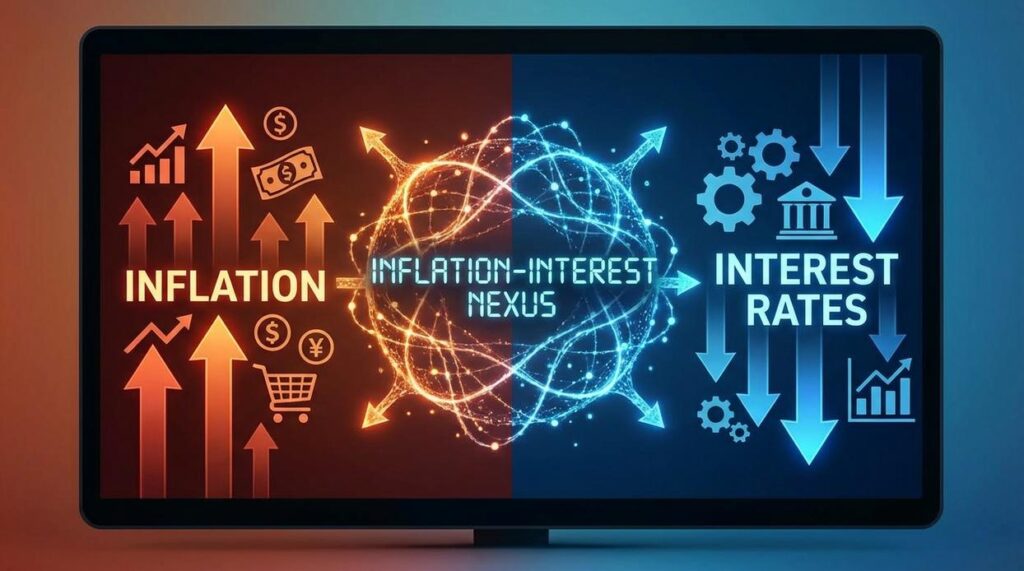
The Critical Link: How Inflation and Interest Rates Influence Each Other

At the center of modern monetary policy sits the Taylor Rule—a guideline suggesting central banks raise interest rates when inflation is high and lower them when inflation is weak. In simple terms, it’s a thermostat for the economy. When prices overheat, policymakers cool things down by making borrowing more expensive. When growth stalls, they cut rates to stimulate spending. Critics argue this framework is too mechanical for a complex economy—and they’re right, to a point. Still, it provides a structured baseline that promotes predictability (which markets love).
However, rate changes don’t work instantly. The lag effect means it can take 6–18 months for higher or lower rates to ripple through loans, hiring decisions, and consumer behavior. For investors, this delay is crucial. Markets often react before the real economy does. Misreading that timing can mean exiting too early—or holding too long (patience isn’t just a virtue; it’s a strategy).
Next, consider real interest rates, defined as nominal rate minus inflation. If a savings account yields 5% but inflation is 3%, the real return is 2%. A positive real rate rewards savers and stabilizes capital allocation. When real rates turn negative, purchasing power erodes—hardly ideal for long-term wealth building.
Finally, rates influence global capital flows. Higher rates attract foreign investors seeking yield, often strengthening a nation’s currency. Lower rates, meanwhile, can push money into equities, venture capital, or alternative assets. Understanding inflation and interest rate trends—especially through tools like using data visualization to spot emerging financial trends early—helps investors position ahead of major shifts rather than react after the fact.
A Practical Framework for Your Own Analysis
A clear framework turns scattered headlines into confident decisions (and fewer 2 a.m. portfolio panics). Here’s how to build yours.
Step 1: Track the Trend, Not the Noise.
Focus on 3‑month and 6‑month moving averages—statistical tools that smooth short‑term volatility—to interpret inflation and interest rate trends. One hot monthly print can mislead; sustained direction is what shapes markets. The benefit? You react to momentum, not media drama.
Step 2: Listen to the Source.
Central bank minutes and press conferences often hint at future policy. Words like “persistent” or “data‑dependent” matter. Reading them yourself gives you an edge over secondhand commentary.
Step 3: Watch the Yield Curve.
An inverted yield curve—when short‑term rates exceed long‑term rates—has preceded most U.S. recessions (Campbell Harvey, Duke University research). Spotting it early helps you reduce risk proactively.
Step 4: Connect to Your Portfolio.
Rising rates typically pressure growth stocks (future profits get discounted more heavily) while value stocks often hold up better. Meanwhile, higher inflation erodes bond prices as yields climb. Apply this, and your strategy becomes intentional—not reactive.
You now have a foundational understanding of how to analyze inflation and interest rates, moving beyond passive observation to active interpretation. The real advantage comes from acting on it. Focus on the predictable link between prices and borrowing costs, then translate that into portfolio decisions. Use inflation and interest rate trends to stress-test your allocations and adjust exposure before markets react.
Recommendations:
- Rebalance proactively, not emotionally.
- Increase cash flow assets when rates rise.
- Add growth assets when disinflation appears.
Treat this framework as a living strategy, revisiting assumptions quarterly to build durable resilience in uncertain economic cycles.
Position Yourself Ahead of the Curve
You came here to better understand how today’s economic forces shape your financial decisions—and now you have a clearer view of the capital flows, on-chain signals, and macro forces driving the market. Most importantly, you can see how inflation and interest rate trends directly influence asset prices, liquidity, and long-term wealth outcomes.
Ignoring these shifts is what keeps portfolios stagnant and financial goals out of reach. Acting on them is what creates strategic advantage.
Now it’s time to turn insight into action. Start applying these frameworks to your portfolio decisions, monitor inflation and interest rate trends consistently, and align your capital with data—not headlines.
If you’re ready to make smarter, more confident financial moves, explore our in-depth tutorials and advanced economic breakdowns today. Thousands of readers rely on our data-driven insights to stay ahead of market cycles—don’t get left behind. Start optimizing your strategy now.
 Chief Economic Strategist
Ask Michael Torresidosan how they got into capital flow strategies and you'll probably get a longer answer than you expected. The short version: Michael started doing it, got genuinely hooked, and at some point realized they had accumulated enough hard-won knowledge that it would be a waste not to share it. So they started writing.
What makes Michael worth reading is that they skips the obvious stuff. Nobody needs another surface-level take on Capital Flow Strategies, Wealth Planning Techniques, Expert Tutorials. What readers actually want is the nuance — the part that only becomes clear after you've made a few mistakes and figured out why. That's the territory Michael operates in. The writing is direct, occasionally blunt, and always built around what's actually true rather than what sounds good in an article. They has little patience for filler, which means they's pieces tend to be denser with real information than the average post on the same subject.
Michael doesn't write to impress anyone. They writes because they has things to say that they genuinely thinks people should hear. That motivation — basic as it sounds — produces something noticeably different from content written for clicks or word count. Readers pick up on it. The comments on Michael's work tend to reflect that.
Chief Economic Strategist
Ask Michael Torresidosan how they got into capital flow strategies and you'll probably get a longer answer than you expected. The short version: Michael started doing it, got genuinely hooked, and at some point realized they had accumulated enough hard-won knowledge that it would be a waste not to share it. So they started writing.
What makes Michael worth reading is that they skips the obvious stuff. Nobody needs another surface-level take on Capital Flow Strategies, Wealth Planning Techniques, Expert Tutorials. What readers actually want is the nuance — the part that only becomes clear after you've made a few mistakes and figured out why. That's the territory Michael operates in. The writing is direct, occasionally blunt, and always built around what's actually true rather than what sounds good in an article. They has little patience for filler, which means they's pieces tend to be denser with real information than the average post on the same subject.
Michael doesn't write to impress anyone. They writes because they has things to say that they genuinely thinks people should hear. That motivation — basic as it sounds — produces something noticeably different from content written for clicks or word count. Readers pick up on it. The comments on Michael's work tend to reflect that.